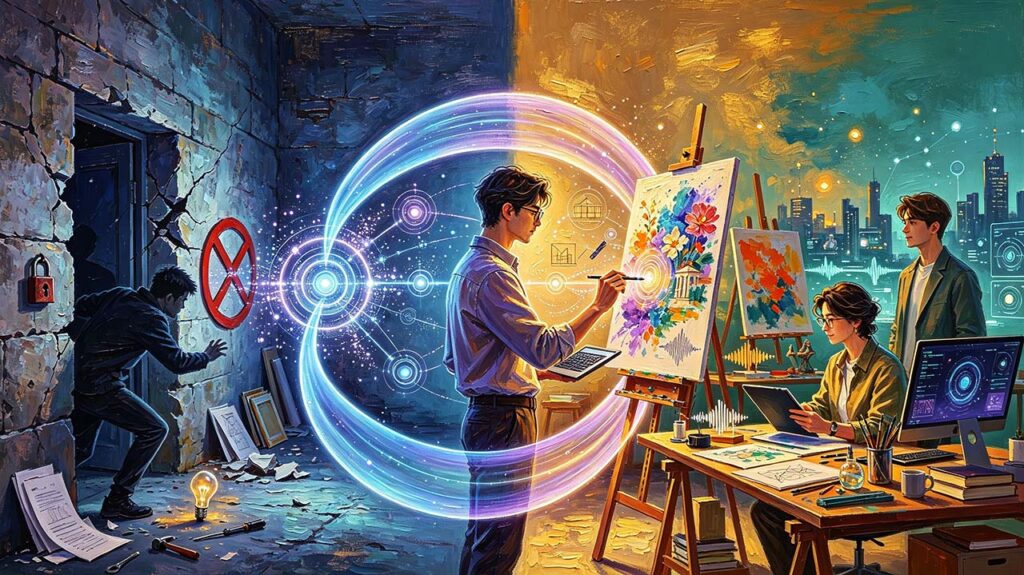
Artificial intelligence is never a threat to human progress, nor is it a forbidden innovation that deserves suppression. It is merely a new journey in the evolution of human civilization — a flexible, boundless journey that empowers both professional advancement and individual artistic self-exploration. To prohibit AI out of fear, doubt, or stubborn conservatism is never a wise choice, but a shallow and short-sighted evasion of progress. Those who blindly call for an AI ban are simply unable to accomplish anything constructive, yet remarkably skilled at spoiling promising possibilities for humanity’s future.
Every technological revolution in human history has been accompanied by hesitation, suspicion, and even blind resistance. When steam engines first replaced manual labor, many feared they would deprive people of livelihoods. When electricity lit up the dark world, countless people worried about unknown risks and tried to resist its popularization. Yet none of these technologies destroyed humanity; instead, they empowered society, optimized industries, and pushed human civilization forward step by step. AI is following the exact same track. It is not an enemy standing opposite humanity, but a multi-dimensional companion walking alongside us in the new era. It bears no inherent will to disrupt the world. All its value, whether in industrial productivity or artistic creation, depends entirely on how humans choose to master and reshape it.
Technology itself is neutral. It carries no inherent good or evil. What defines the outcome of technological development is human cognition, aesthetic perception, and creative judgment. Beyond boosting professional efficiency and simplifying repetitive labor, AI opens unprecedented doors for **artistic practice and self-exploration** — a dimension of growth that cannot be ignored in modern self-development.
For artists, creators, and every individual pursuing self-expression, AI dissolves the traditional boundaries of art creation. It turns abstract inspiration, subtle inner emotions, and unformed aesthetic imagination into tangible visual, auditory, and literary works. It provides unlimited trial spaces for artistic experimentation: creators can iterate artistic styles, integrate traditional aesthetics with futuristic imagination, and break free from the limitations of manual techniques and material constraints. AI does not replace human creativity; it amplifies human sensitivity, expands the scope of artistic expression, and offers every individual a low-threshold, diverse platform to explore inner self, polish personal style, and complete spiritual self-expression.
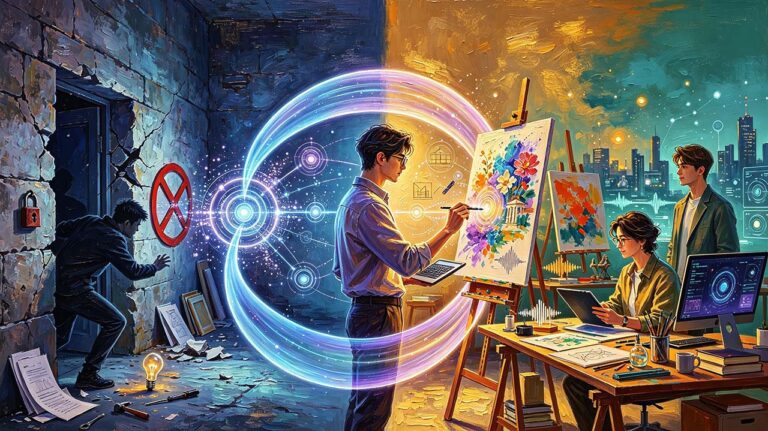
In this sense, AI serves dual value for humanity. On one hand, it empowers all walks of professional life, freeing humans from trivial mechanical work to focus on logical thinking, strategic innovation, and industrial breakthroughs. On the other hand, it enriches our spiritual world, providing endless possibilities for aesthetic practice, artistic exploration, and self-discovery. It bridges the gap between ordinary life and creative art, allowing everyone to become a discoverer of beauty and a creator of unique personal expression.
Those who advocate prohibiting AI completely fail to recognize this dual value of technology. They only fixate on superficial uncertainties brought by emerging technology, while blindly stifling the infinite potential of industrial upgrading and artistic innovation. Their rigid resistance brings no progress to society; instead, it erases precious opportunities for individual self-breakthrough and artistic diversity. They intend to maintain stability by rejecting change, yet they end up ruining the most valuable chances of self-growth and cultural prosperity — a perfect embodiment of being unable to accomplish good, yet fully capable of messing everything up.
Progress never arises from rejection and closure, but from acceptance, learning, and creative integration. We should never waste energy on resisting emerging technology. Instead, we should take the initiative to understand AI, master its application logic, and guide it to serve both our professional careers and our artistic self-exploration. We can use it to optimize work efficiency, and meanwhile utilize it as a creative medium to release inspiration, polish aesthetic taste, and complete continuous self-discovery in artistic practice.
AI is merely the starting point of a brand-new journey for human productivity and spiritual creation. The future does not belong to those who fear and ban technology, but to those who learn, adapt, and re-create with it. Blind prohibition is futile and counterproductive. Only by rationally embracing AI, balancing its practical professional value and artistic exploratory value, can we turn technological power into the driving force of social progress, personal growth, and eternal artistic innovation.